<?xml version="1.0" encoding="utf-8"?><feed xmlns="http://www.w3.org/2005/Atom" ><generator uri="https://jekyllrb.com/" version="3.10.0">Jekyll</generator><link href="https://cynthia-xinyuwang.github.io/feed.xml" rel="self" type="application/atom+xml" /><link href="https://cynthia-xinyuwang.github.io/" rel="alternate" type="text/html" /><updated>2026-10-24T14:41:57+00:00</updated><id>https://cynthia-xinyuwang.github.io/feed.xml</id><title type="html">Xinyu Wang’s Personal Homepage</title><subtitle>Research Fellow at HKPolyU</subtitle><author><name>Xinyu Wang</name><email>cynthia-xinyu.wang@polyu.edu.hk</email></author><entry><title type="html">Understanding Factor Investment in an Unified Framework</title><link href="https://cynthia-xinyuwang.github.io/posts/2013/08/blog-post-2/" rel="alternate" type="text/html" title="Understanding Factor Investment in an Unified Framework" /><published>2024-12-22T00:00:00+00:00</published><updated>2024-12-22T00:00:00+00:00</updated><id>https://cynthia-xinyuwang.github.io/posts/2013/08/blog-post-2</id><content type="html" xml:base="https://cynthia-xinyuwang.github.io/posts/2013/08/blog-post-2/"><![CDATA[<p>Factor investing has become a cornerstone of modern finance, bridging the gap between academic theory and real-world application. Whether you’re a senior undergraduate exploring career options or a postgraduate delving deeper into finance, understanding this strategy can be a game-changer. One essential resource that can guide you on this journey is the paper <a href="https://www.pm-research.com/content/iijpormgmt/44/4/10">Academic, Practitioner, and Investor Perspectives on Factor Investing</a> published in the Journal of Portfolio Management. This paper offers a comprehensive look at the nuances of factor investing, helping readers appreciate its varied roles across academia, industry, and investment practice.</p>

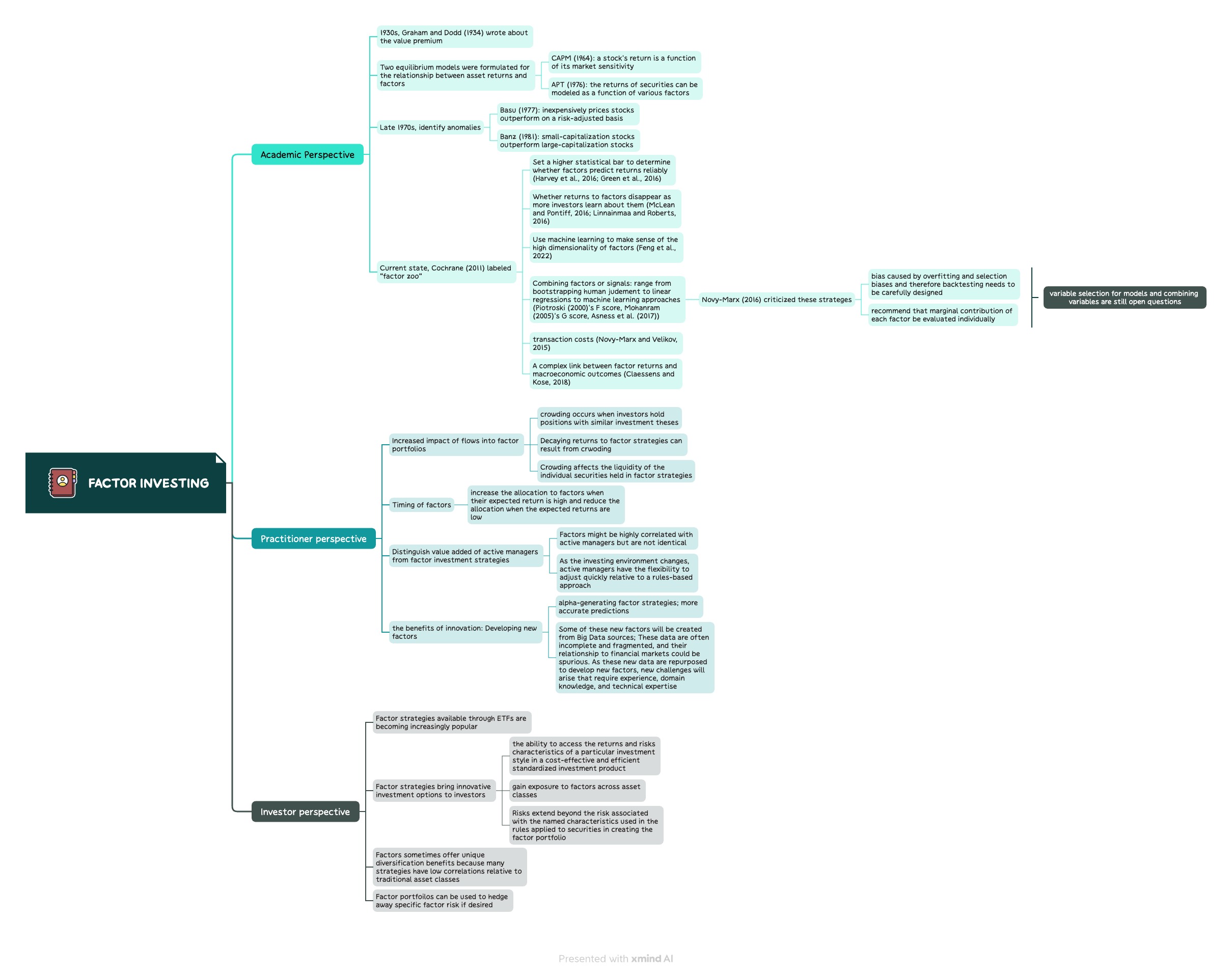
<p>In academic circles, factor investing is fundamentally about uncovering the risk-return profiles of securities. For decades, scholars have sought to explain market anomalies and systematic risks through factors. However, as research evolved, the proliferation of factors led economist John Cochrane to describe the current state of affairs as a “factor zoo.”
This abundance of factors has sparked efforts to “tame the zoo.” Key approaches include:</p>
<ul>
  <li><strong>Setting Higher Statistical Standards:</strong> Researchers aim to distinguish genuine factors from statistical noise by imposing rigorous criteria.</li>
  <li><strong>Critiques of Data Snooping:</strong> Some argue that many identified factors arise from overfitting historical data, lacking true predictive power.</li>
  <li><strong>Machine Learning Innovations:</strong> Advanced techniques are now being used to build composite strategies, integrating multiple factors into coherent frameworks.</li>
  <li><strong>Transaction Costs and Implementation:</strong> Scholars are increasingly examining how trading costs impact the real-world viability of factor-based strategies.</li>
</ul>

<p>In the investment world, factor strategies take on different roles for institutional and retail investors:</p>
<ul>
  <li>
    <p><strong>Institutional Investors:</strong> Large institutions often deploy multi-factor strategies, but this widespread adoption can lead to <em>crowding effects</em>, reducing their effectiveness. <em>Factor timing</em> is another area of interest. Additionally, institutional players are leveraging <em>Big Data sources</em> to gain an edge.</p>
  </li>
  <li>
    <p><em>*Retail Investors:</em> For individual investors, factor-based ETFs have democratized access to these strategies. These funds offer exposure to specific investment styles (e.g., value, growth, momentum) without requiring the deep expertise or resources of institutional players.</p>
  </li>
</ul>

<p><strong><em>Why read this paper</em></strong></p>
<ul>
  <li>
    <p><strong>Bridging Theory and Practice:</strong> It connects academic findings with real-world applications, showing how each perspective enriches the other.</p>
  </li>
  <li>
    <p><strong>Career Decision-Making:</strong> By understanding how factors are used differently in various settings, you can better align your learning with your career goals.</p>
  </li>
  <li>
    <p><strong>Mindmap Support:</strong> For ease of comprehension, I’ve created a <a href="https://Cynthia-XinyuWang.github.io/assets/Factor_investment.jpeg">mindmap</a> to help you navigate the paper’s key ideas.</p>
  </li>
</ul>

<p>Factor investing is a dynamic field that thrives on collaboration and new ideas. If you have insights, questions, or alternative perspectives, feel free to share them. Let’s explore this exciting area of finance together.</p>

<p>By embracing a multi-faceted understanding of factor investing, you’ll not only enhance your knowledge but also position yourself to make informed decisions—whether in academia, industry, or your personal investment journey.</p>]]></content><author><name>Xinyu Wang</name><email>cynthia-xinyu.wang@polyu.edu.hk</email></author><category term="Empirical Asset Pricing" /><category term="Literature Review" /><summary type="html"><![CDATA[Factor investing has become a cornerstone of modern finance, bridging the gap between academic theory and real-world application. Whether you’re a senior undergraduate exploring career options or a postgraduate delving deeper into finance, understanding this strategy can be a game-changer. One essential resource that can guide you on this journey is the paper Academic, Practitioner, and Investor Perspectives on Factor Investing published in the Journal of Portfolio Management. This paper offers a comprehensive look at the nuances of factor investing, helping readers appreciate its varied roles across academia, industry, and investment practice.]]></summary></entry><entry><title type="html">Understanding Asset Prices</title><link href="https://cynthia-xinyuwang.github.io/posts/2012/08/blog-post-1/" rel="alternate" type="text/html" title="Understanding Asset Prices" /><published>2024-12-21T00:00:00+00:00</published><updated>2024-12-21T00:00:00+00:00</updated><id>https://cynthia-xinyuwang.github.io/posts/2012/08/blog-post-1</id><content type="html" xml:base="https://cynthia-xinyuwang.github.io/posts/2012/08/blog-post-1/"><![CDATA[<p>If you’re stepping into the world of financial econometrics and empirical asset pricing, there’s no better starting point than <a href="https://www.nobelprize.org/uploads/2013/10/advanced-economicsciences2013.pdf">the document prepared by the Economic Sciences Prize Committee of the Royal Swedish Academy of Sciences</a>. This comprehensive work is a masterclass on the transformative contributions of Eugene Fama, Lars Peter Hansen, and Robert Shiller, whose groundbreaking research has redefined how we understand asset prices. The followings are Key Takeaways from the Document:</p>

<h3 id="time-series-patterns">Time-series Patterns</h3>
<ul>
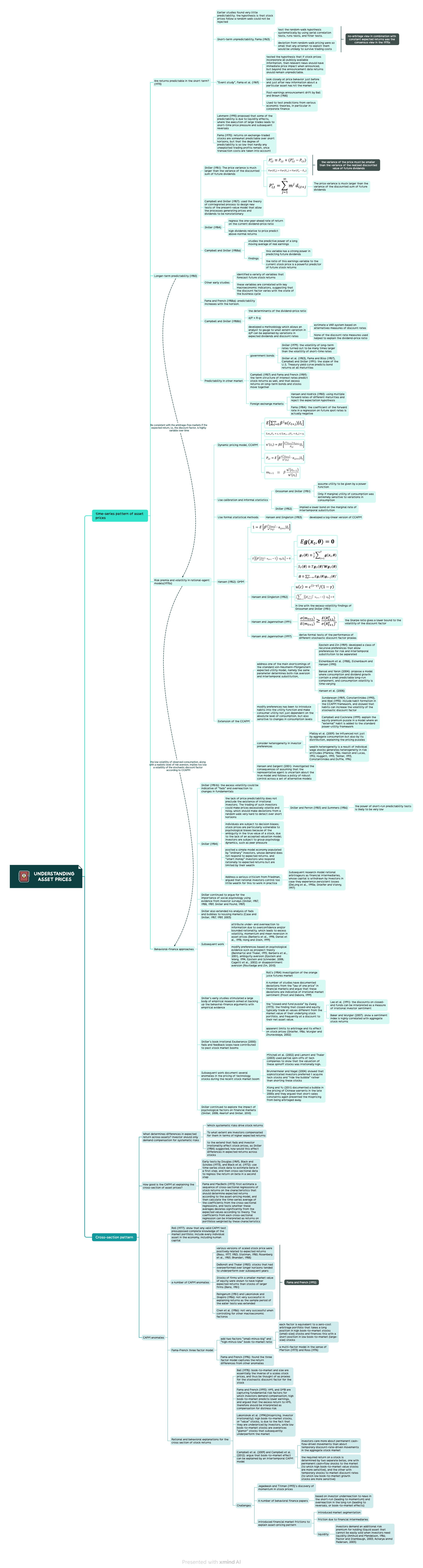
  <li><strong>Short-term unpredictability:</strong> Fama’s research in the 1970s established the foundational consensus that <strong>short-term</strong> stock returns are unpredictable.</li>
  <li><strong>Long-term predictability:</strong> Moving into the 1980s, Shiller demonstrated the <strong>long-term</strong> predictability of stock returns, uncovering economically significant patterns that implied substantial time variation in discount factors. This revelation spurred the adoption of the consumption-based CAPM (CCAPM) to explain excess variability in stochastic discount factors.</li>
  <li><strong>Estimate CCAPM equations:</strong> However, estimating the <strong>non-linear CCAPM equation</strong> was challenging until Hansen introduced the <strong>Generalized Method of Moments (GMM)</strong>, enabling robust estimations. Despite these advancements, the variability in discount factors remained inadequately explained.</li>
  <li><strong>Interpret the excess variablity through behaviral finance:</strong> Shiller leveraged <strong>behavioral finance</strong> to provide a compelling interpretation of market fluctuations.</li>
</ul>

<h3 id="cross-sectional-patterns">Cross-sectional patterns</h3>
<ul>
  <li><strong>Fama-MacBeth regression:</strong> Fama pioneered the two-pass regression methodology to address cross-sectional dependence in asset pricing models.</li>
  <li><strong>Fama-French three-factor model:</strong> Fama further advanced the field with his renowned three factor model, which addressed anomalies that the traditional CAPM failed to explain, significantly enriching our understanding of the U.S. stock market.</li>
</ul>

<p>This resource doesn’t just summarize decades of research—it offers a panoramic view of the intellectual journey that has shaped empirical asset pricing. By contextualizing the breakthroughs of Fama, Hansen, and Shiller within the broader evolution of financial thought, the document serves as both a history lesson and a guide for future inquiry.</p>

<p>To help readers navigate this extensive material, I’ve created a <a href="https://cynthia-xinyuwang.github.io/assets/1.png">mind map</a> summarizing the core ideas and their interconnections. This visual guide highlights key concepts, methodologies, and milestones in the evolution of asset pricing research. Additionally, I’ve translated the theoretical background section into <a href="https://cynthia-xinyuwang.github.io/assets/translation1.pdf">Chinese</a> and provided supplementary explanations for the derivation steps between equations. These enhancements are designed to make the document more accessible, especially for readers who are new to the field or not fully comfortable with the original text.</p>

<p>If this document sparks ideas or questions, I’d love to hear your thoughts! Whether you’re curious about the methodologies, intrigued by the behavioral explanations, or have insights on the future of asset pricing, let’s discuss and explore this fascinating field together.</p>

<p>By immersing yourself in the works of these financial pioneers, you’ll not only gain a deeper understanding of asset pricing but also develop a richer perspective on how academic theories translate into real-world applications.</p>]]></content><author><name>Xinyu Wang</name><email>cynthia-xinyu.wang@polyu.edu.hk</email></author><category term="Empirical Asset Pricing" /><category term="Literature Review" /><summary type="html"><![CDATA[If you’re stepping into the world of financial econometrics and empirical asset pricing, there’s no better starting point than the document prepared by the Economic Sciences Prize Committee of the Royal Swedish Academy of Sciences. This comprehensive work is a masterclass on the transformative contributions of Eugene Fama, Lars Peter Hansen, and Robert Shiller, whose groundbreaking research has redefined how we understand asset prices. The followings are Key Takeaways from the Document:]]></summary></entry></feed>