
Understanding Asset Prices
Published:
If you’re stepping into the world of financial econometrics and empirical asset pricing, there’s no better starting point than the document prepared by the Economic Sciences Prize Committee of the Royal Swedish Academy of Sciences. This comprehensive work is a masterclass on the transformative contributions of Eugene Fama, Lars Peter Hansen, and Robert Shiller, whose groundbreaking research has redefined how we understand asset prices. The followings are Key Takeaways from the Document:
Time-series Patterns
- Short-term unpredictability: Fama’s research in the 1970s established the foundational consensus that short-term stock returns are unpredictable.
- Long-term predictability: Moving into the 1980s, Shiller demonstrated the long-term predictability of stock returns, uncovering economically significant patterns that implied substantial time variation in discount factors. This revelation spurred the adoption of the consumption-based CAPM (CCAPM) to explain excess variability in stochastic discount factors.
- Estimate CCAPM equations: However, estimating the non-linear CCAPM equation was challenging until Hansen introduced the Generalized Method of Moments (GMM), enabling robust estimations. Despite these advancements, the variability in discount factors remained inadequately explained.
- Interpret the excess variablity through behaviral finance: Shiller leveraged behavioral finance to provide a compelling interpretation of market fluctuations.
Cross-sectional patterns
- Fama-MacBeth regression: Fama pioneered the two-pass regression methodology to address cross-sectional dependence in asset pricing models.
- Fama-French three-factor model: Fama further advanced the field with his renowned three factor model, which addressed anomalies that the traditional CAPM failed to explain, significantly enriching our understanding of the U.S. stock market.
This resource doesn’t just summarize decades of research—it offers a panoramic view of the intellectual journey that has shaped empirical asset pricing. By contextualizing the breakthroughs of Fama, Hansen, and Shiller within the broader evolution of financial thought, the document serves as both a history lesson and a guide for future inquiry.
To help readers navigate this extensive material, I’ve created a mind map summarizing the core ideas and their interconnections. This visual guide highlights key concepts, methodologies, and milestones in the evolution of asset pricing research. Additionally, I’ve translated the theoretical background section into Chinese and provided supplementary explanations for the derivation steps between equations. These enhancements are designed to make the document more accessible, especially for readers who are new to the field or not fully comfortable with the original text.
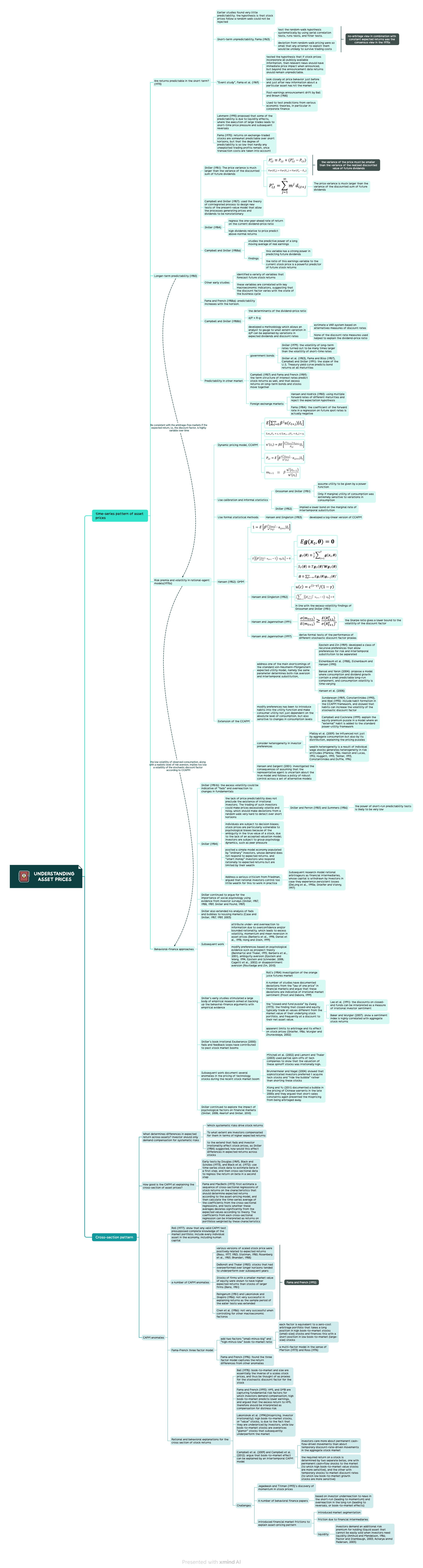
If this document sparks ideas or questions, I’d love to hear your thoughts! Whether you’re curious about the methodologies, intrigued by the behavioral explanations, or have insights on the future of asset pricing, let’s discuss and explore this fascinating field together.
By immersing yourself in the works of these financial pioneers, you’ll not only gain a deeper understanding of asset pricing but also develop a richer perspective on how academic theories translate into real-world applications.