
Understanding Factor Investment in an Unified Framework
Published:
Factor investing has become a cornerstone of modern finance, bridging the gap between academic theory and real-world application. Whether you’re a senior undergraduate exploring career options or a postgraduate delving deeper into finance, understanding this strategy can be a game-changer. One essential resource that can guide you on this journey is the paper Academic, Practitioner, and Investor Perspectives on Factor Investing published in the Journal of Portfolio Management. This paper offers a comprehensive look at the nuances of factor investing, helping readers appreciate its varied roles across academia, industry, and investment practice.
In academic circles, factor investing is fundamentally about uncovering the risk-return profiles of securities. For decades, scholars have sought to explain market anomalies and systematic risks through factors. However, as research evolved, the proliferation of factors led economist John Cochrane to describe the current state of affairs as a “factor zoo.” This abundance of factors has sparked efforts to “tame the zoo.” Key approaches include:
- Setting Higher Statistical Standards: Researchers aim to distinguish genuine factors from statistical noise by imposing rigorous criteria.
- Critiques of Data Snooping: Some argue that many identified factors arise from overfitting historical data, lacking true predictive power.
- Machine Learning Innovations: Advanced techniques are now being used to build composite strategies, integrating multiple factors into coherent frameworks.
- Transaction Costs and Implementation: Scholars are increasingly examining how trading costs impact the real-world viability of factor-based strategies.
In the investment world, factor strategies take on different roles for institutional and retail investors:
Institutional Investors: Large institutions often deploy multi-factor strategies, but this widespread adoption can lead to crowding effects, reducing their effectiveness. Factor timing is another area of interest. Additionally, institutional players are leveraging Big Data sources to gain an edge.
*Retail Investors: For individual investors, factor-based ETFs have democratized access to these strategies. These funds offer exposure to specific investment styles (e.g., value, growth, momentum) without requiring the deep expertise or resources of institutional players.
Why read this paper
Bridging Theory and Practice: It connects academic findings with real-world applications, showing how each perspective enriches the other.
Career Decision-Making: By understanding how factors are used differently in various settings, you can better align your learning with your career goals.
Mindmap Support: For ease of comprehension, I’ve created a mindmap to help you navigate the paper’s key ideas.
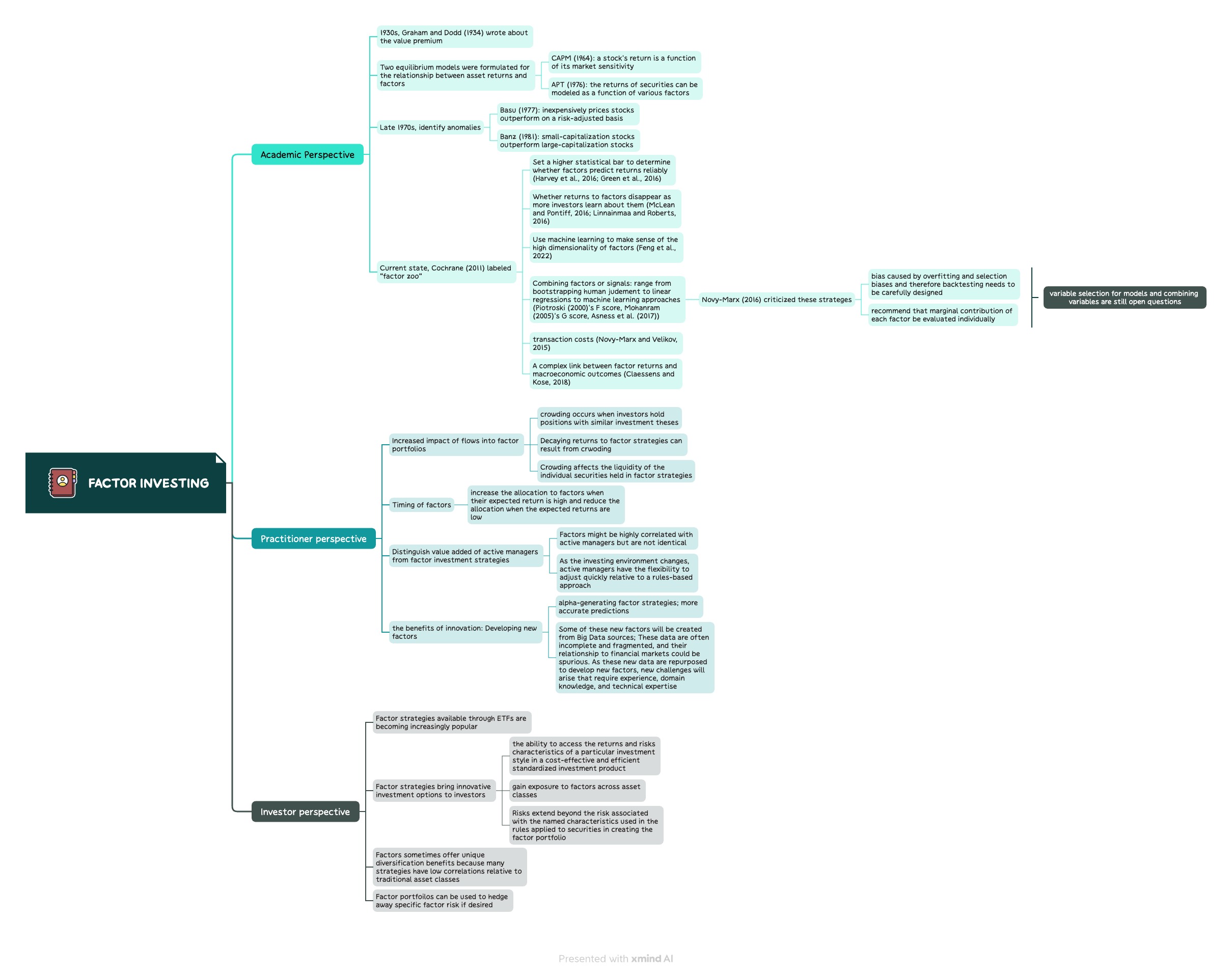
Factor investing is a dynamic field that thrives on collaboration and new ideas. If you have insights, questions, or alternative perspectives, feel free to share them. Let’s explore this exciting area of finance together.
By embracing a multi-faceted understanding of factor investing, you’ll not only enhance your knowledge but also position yourself to make informed decisions—whether in academia, industry, or your personal investment journey.